
Displaced families of Shuklaphanta end 210-day hunger strike after assurance from MP Bohara
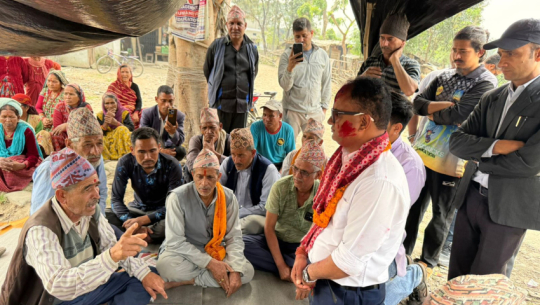
Kanchanpur: Families displaced during the expansion of Shuklaphanta National Park ended their hunger strike on Monday after continuing it for 210 days while demanding rehabilitation.
The displaced families ended their hunger strike in the presence of newly elected member of the House of Representatives Deepak Raj Bohara. The fast was called off after Bohara, elected from Kanchanpur Constituency No. 2, pledged to take initiatives to resolve the issue of permanent settlement for the displaced families.
Families displaced during the expansion of Shuklaphanta National Park (then Shuklaphanta Reserve) had long been protesting for rehabilitation. Recently, they had been staging a continuous hunger strike by pitching tents along the roadside near Banhara in Krishnapur Municipality-2, pressuring the government and concerned authorities to address the issue.
Newly elected MP Bohara expressed commitment to prioritize the issue, stating that the problem of the displaced families is serious. He said he would review reports prepared by various commissions formed in the past and take concrete initiatives for rehabilitation. “Your problems should have been resolved many years ago, but they were not,” he said, adding that he would seek solutions through further discussions and interactions with the affected families. He also urged them to end the fast, citing the risk of accidents while sitting on the roadside.
While ending the hunger strike, Prem Dutt Bhatta, Chairman of the Reserve Displaced Persons Struggle Committee, said the decision was made based on trust in the newly elected MP Bohara. “We have sent you to the parliament with trust,” he said, expressing hope that the actions of previous MPs and governments would not be repeated. According to Bhatta, although 34 commissions have been formed so far to resolve the issue of reserve displaced persons, no concrete achievements have been made.
Bhatta said that at times the Forest Act was used as a reason to hinder the rehabilitation of displaced families, while at other times government instability was cited as an obstacle. He recalled that before displacement they owned five bighas of land and expressed sorrow that they are now in a situation of being homeless. According to the displaced families, 2,473 families have been living in various camps so far, enduring a difficult life for years while waiting for permanent rehabilitation.

Dineshkhabar Desk