Environmental impact assessment underway for 800 MW west Seti hydropower project
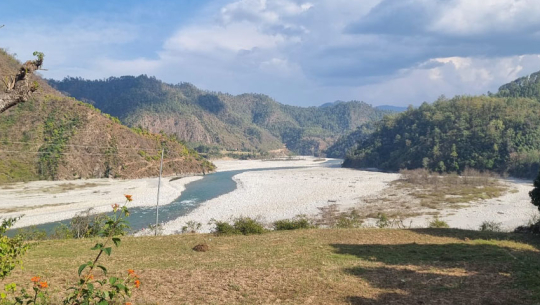
Dadeldhura: The Environmental Impact Assessment (EIA) of the long-awaited 800 MW West Seti Hydropower Project, a national dream for the past four decades, has officially begun. Locals from the affected areas have been requested to provide necessary information for the study.
Z Consult Pvt. Ltd., the consultant company representing Indian developer NHPC India Limited, has urged residents to share house and land ownership details as part of the EIA process. According to supervisor Dinesh Chandra Joshi of Z Consult, the social impact survey—including collection of household and land records—commenced on Bhadra 22.
Affected areas under the project include Navadurga Rural Municipality Wards 4 and 5 of Dadeldhura; Sigas Rural Municipality Wards 5, 6, and 7 of Baitadi; Adarsh Rural Municipality Wards 3, 5, and 6, and Sayal Rural Municipality Ward 1 of Doti; Kedarsyu Rural Municipality Wards 1 and 2 of Bajhang; and Bitthadchir Rural Municipality Ward 9.
The government had initiated the process of awarding the project to NHPC in Chaitra 2078 after terminating its agreement with the Chinese company Three Gorges. Earlier, both Australian company SMEC and Three Gorges had failed to move the project forward despite years of negotiations.
Three Gorges formally withdrew in Bhadra 2075, citing challenges related to geology, dam height, and rehabilitation of affected communities. Even after proposals to reduce the project capacity from 750 to 620 MW and sign a Power Purchase Agreement (PPA) in US dollars, the company deemed it financially unfeasible.
Earlier, Australian company SMEC had also held the license for 25 years but failed to make progress despite 10 renewals over 17 years. The government ultimately revoked its license in 2012 before handing the project to Three Gorges.
Following these setbacks, the Investment Board studied alternatives and proposed the SR-6 project—a 450 MW reservoir-based project located slightly downstream in Doti and Achham districts. The SR-6 site lies close to the Dipayal-Gauguda rural road corridor.
A Japanese International Cooperation Agency (JICA) study suggested that West Seti could be developed to generate up to 652 MW with the construction of a 207-meter-high dam, or 228 MW if its capacity were halved.
The Investment Board has argued that if developed together, West Seti (750 MW) and SR-6 (450 MW) could be optimized by coordinating water storage, electricity generation, and release, maximizing overall output. SR-6 would include a 1.5 km headrace tunnel and an open-site powerhouse.

Dineshkhabar Desk