
Disaster preparedness campaign launched across five municipalities in Kanchanpur
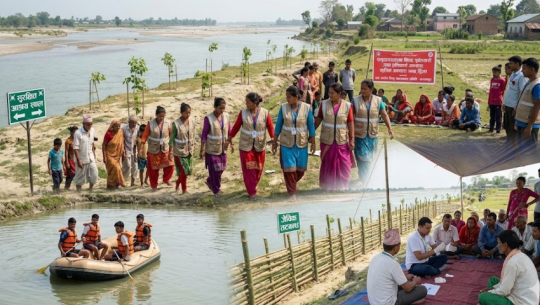
Kanchanpur: A campaign has been launched to expand disaster preparedness to the community level in five local levels of Kanchanpur.
Various programs have been initiated to strengthen and activate ward-level disaster management committees with the aim of minimizing human and material losses caused by potential disasters.
The campaign has been launched to reduce losses from floods, inundations, extreme heat (hu) and fire incidents.
Orientation on rescue operations, first aid, early warning system operation, relief management and disaster awareness has been provided to ward-level disaster management committee members of Shuklaphanta, Bhimdatta, Belauri and Punarbas municipalities and Laljhadi Rural Municipality, which are considered high-risk disaster areas.
The program is being implemented in collaboration with local levels under the “Climate Resilient Program for Communities,” jointly run by the Environmental Protection and Social Welfare Association (PESWAN) and Practical Action.
According to Janak Lekhak, technical supervisor of PESWAN, the training aims to strengthen community capacity in response to increasing impacts of climate change.
“Rather than engaging in rescue only after a disaster, it is necessary to keep the community prepared beforehand,” he said. “Accordingly, work is being done to activate groups related to early warning, rescue, first aid and relief management.”
Rescue materials as per standards set by the National Disaster Risk Reduction and Management Authority will also be provided to the committees. Practical exercises on the use and management of these materials are also ongoing.
Through the program, disaster experts are providing information on precautions and preparedness measures for floods, fires and heat waves. Training has also been provided on the use of search and rescue equipment.
Disaster expert Prabhunidhi Pant stressed the need to include risk assessment and climate adaptation as mandatory components in local development planning.
“Risk management should be prioritized at the planning stage for sustainable development,” he said. “Long-term achievements can be achieved only if climate change and disaster management issues are included in local policies and programs.”
Under the program, mock drills related to flood disasters have been conducted in 17 communities across all five municipalities. Processes including flood warning dissemination, evacuation to safe areas, rescue operations and relief distribution have been practiced at the community level.
Various structural and environmental measures have also been adopted for risk reduction. Biological embankments have been constructed in river erosion-prone areas, while “safe houses” are being built in Belauri and Bhimdatta municipalities for shelter during disasters. Preparations are also underway for tree plantation programs in riverside areas.
Similarly, plans have been included to construct pavilions in public places to reduce the impact of heat. Programs are also being prepared to integrate climate change and disaster management issues into school improvement plans.
Shuklaphanta Municipality Mayor Rana Bahadur Mahara expressed confidence that such community-based programs will make disaster management more effective.
“The effects of climate change are being directly seen in villages and settlements,” he said. “If public awareness, skills and coordination can be increased in time, the damage caused by disasters can be significantly reduced. Collaboration between local levels, communities and development partners is the need of the hour.”
It is believed that such preparedness programs conducted with community participation will help build local capacity as well as enable quick and effective responses during disasters.