
Displaced families and encroachment threaten forest conservation in Chure rural municipality, Kailali
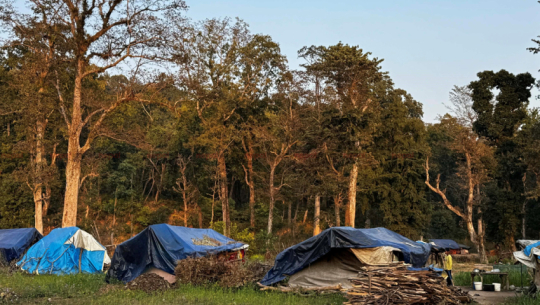
Kailali: Forest conservation in Chure Rural Municipality, Kailali, is facing increasing pressure as displaced families and encroachment threaten the fragile ecosystem. Bishnadevi Mahara and her family have been living under a tent in Panerugada, Chure Rural Municipality-4, for the past five years after a landslide in 2077 BS destroyed their house and 16 ropanis of farmland in Gaujana.
After being removed from forest land and temporary shelters, Bishnadevi returned to the forest with her two sons while seeking employment in India to sustain her family. She expressed concern over safety risks from wild animals and tigers, lack of housing, and the uncertain future for her children. Similarly, Kamala Roka Magar and Double Bahadur Karki have been living under tents in the same area since 2077 BS, struggling with fear of falling trees, wild animals, and the absence of permanent housing.
Currently, over 25 families reside in tents in Panerugada, while a total of 116 families displaced by floods, landslides, and natural disasters of 2077 BS live in temporary settlements across Panerugada, Tankagada, Baluwagada, Khamahale, and Khanidanda. Despite efforts by the forest office to remove encroachers in 2079 BS, many of the real victims remain in the forest due to the lack of alternative housing. Children face significant challenges attending school, especially during floods, with some walking halfway to Shiva Namuna Basic School in Gauriganga Municipality-3.
Forest encroachment in Kailali and Kanchanpur extends beyond displaced families. Areas around Basanta Corridor, Attariya, Chisapani, and Shuklaphanta National Park have been increasingly encroached in recent years. The 62nd Annual Report of the Auditor General (2020) notes that about 14,000 hectares of forest were encroached nationwide, with more than 38 percent in Kailali alone. Forest Research and Survey Department data indicate that of Kailali’s 328,716 hectares, 2573 hectares are forested, with approximately 17,000 hectares encroached over the past eight years. The ‘Our Forest’ report (2020) estimates 21,404 hectares of forest encroachment in Kailali, with the latest Auditor General report raising the figure to 38,040 hectares. Dadeldhura and Kanchanpur have also seen significant encroachment, with 15,120 and 9,859 hectares respectively.
Community forests face repeated encroachments despite efforts to remove them. Hariram Dagoura, chairman of Madreniya Community Forest, noted that three bighas of land were re-encroached even after crops were cleared, highlighting the challenge of enforcing forest management. Similarly, Ved Prasad Chaudhary, chairman of Janhit Community Forest, emphasized that local awareness and participation are critical in preventing encroachment.
Division Forest Officer Janak Padhya cites population growth, migration from mountains to Terai, poverty, and lack of employment as key drivers of encroachment. Land mafias exploit vulnerable groups, and political influence often undermines enforcement. Human-wildlife conflicts are increasing as forest fragmentation continues, according to Senior Divisional Forest Officer Ram Bichari Thakur.
Officials stress that public awareness, strict monitoring, and effective enforcement are essential. Hemraj Bista, Director of the Sudurpaschim Province Forest Directorate, emphasizes that forest encroachment is not only an individual issue but also organized criminal activity, with some local government structures contributing to the problem.
Efforts to control encroachment include awareness programs, coordination meetings, joint monitoring, clearing encroached areas, constructing fences, and tree planting. In the previous fiscal year, 135 hectares of forest were cleared of encroachment in Kailali. The government has implemented the “Forest Encroachment Control and Management Strategy, 2068,” which aims to restore encroached lands, provide alternative livelihoods, and maintain forests under group management or agro-forestry systems, while prohibiting individual or institutional registration of forest land.
Under the Forest Act 2076, encroachment in national forests and protected areas is a punishable offense, with imprisonment of up to five years, fines of up to Rs 100,000, or both. Despite these provisions, forest encroachment continues to rise due to a lack of alternative housing for displaced families, political interference, and the activities of land mafias, posing a significant challenge to forest conservation in the region.