
Decades-long struggle: Rehabilitation of Shuklaphanta National Park displaced families remains unresolved
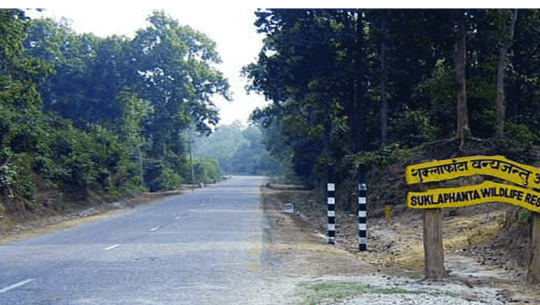
Kanchanpur: Nearly five decades after the expansion of Shuklaphanta National Park, the issue of rehabilitating displaced families remains unresolved, leaving affected communities in continued protest. The displacement, which began in 2033 BS, has yet to see a lasting solution.
Gaj Bahadur Bista, 65, of Bani, Krishnapur Municipality-2, Kanchanpur, has participated in every election since the 2036 BS referendum. Despite this, his family, displaced in 2058 BS during the expansion of the former Shuklaphanta Wildlife Reserve, has not been rehabilitated. They currently live in temporary huts on government land at the Herbs Office in Mahendranagar as part of an ongoing protest.
According to displaced residents, while political parties repeatedly pledged rehabilitation during elections, no concrete action has been taken. Tek Bahadur Tamta and Ramesh Tamrakar emphasized that despite political transitions, constitution-making, and frequent changes in government, their plight remains unresolved.
At present, 2,473 displaced families reside in 14 camps across Kanchanpur and surrounding areas. The Dhaka camp near Shuklaphanta National Park hosts over 600 families, Tarapur has 180, and Lallare Danda has 13. Several families continue to live temporarily on the park’s edges and in forest areas.
Shuklaphanta was originally declared a wildlife reserve in 2033 BS, expanded from a royal hunting reserve to 305 square kilometers by 2058 BS, prompting evacuations of local settlements. It was upgraded to a national park in 2073 BS.
Since 2037 BS, 32 commissions and committees have been formed to address rehabilitation. These commissions have provided varying reports on the number of displaced families and the proposed rehabilitation modalities. The 2071 BS commission led by Thakur Prasad Sharma identified 1,480 families as displaced, while earlier reports listed 2,473 families.
The 32nd commission, coordinated by former judge Jayanand Paneru, submitted its report on 26 Poush 2081 BS, identifying 2,027 displaced families. It recommended immediate relocation for those living within park and forest areas, providing Rs 1 million per family. Families living outside forest areas were advised to receive Rs 700,000, and those unable to use their land despite receiving titles were to receive Rs 500,000.
For decades, the rehabilitation process has largely remained confined to reports and commissions, leaving displaced families in prolonged uncertainty and destabilized livelihoods.

Dineshkhabar Desk