
Beekeeping proposed as solution to drive away wild elephants in Kanchanpur
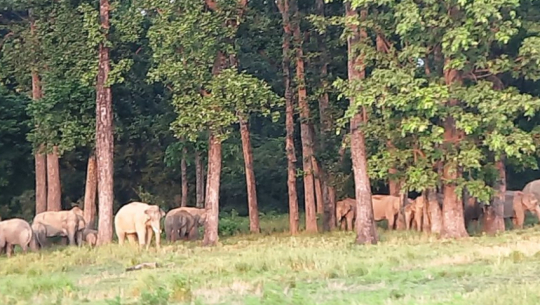
Kanchanpur: Farmers living in the buffer zone settlements of Shuklaphanta National Park in Kanchanpur have been forced to stay awake all night to protect their crops from wild elephants.
Elephants have been destroying crops such as rice, maize, and sugarcane planted in the fields. Despite efforts to scare them away using fire, firecrackers, and metal noises, the herds only return to the park and surrounding forests after feeding. Farmers say the elephants reappear before dusk, continuing the destruction until harvest time, posing increasing risks to both life and property.
As traditional methods have failed to repel the elephants, local farmers are exploring alternative solutions. According to Punaram Chaudhary, General Secretary of the Far-Western Province Working Committee of the National Federation of Community Forests and a wildlife expert, beekeeping could be an effective deterrent. “Elephants avoid places where bees are present,” he said. “They dislike the buzzing sound of bees, which keeps them away.”
Chaudhary said that this technique was successfully implemented in the Kanchan Community Forest of Dandajain, Laljhadi Rural Municipality-4. “A decade ago, beehives were placed along the forest route regularly used by elephants, and they stopped using it,” he said. “However, the local community did not continue the practice, and now they are facing the problem again.”
He added that beekeeping not only helps drive away elephants but also provides income to locals through honey production. “This method should be expanded further,” he emphasized.
Chaudhary also shared that, during a Nepal-India cross-border wildlife discussion in 2074 BS, another technique using a mixture of chili, mobil oil, and tobacco was tested. “We applied the mixture to jute ropes and stretched them in three layers like barbed wire along the elephant path,” he said. “After that, elephants stopped using that route and started moving towards the Doda River.” He explained that the strong odor of the mixture repels elephants, and when it touches their skin, it causes a burning sensation.
As a third alternative, experts have suggested cultivating herbs such as mint and chamomile in elephant-affected areas. These herbs not only help repel elephants but can also generate income for farmers if a sustainable market is ensured.
“In the past, with donor support, locals were trained and provided machines for herbal cultivation and processing,” said Hawaldar Chaudhary of the Sundevi Consumers’ Committee. “But since there was no market, farmers stopped growing herbs, and the machines have now rusted and remain unused.”
The elephant menace has become a growing challenge for farmers in the buffer zones. Experts believe that adopting solutions such as beekeeping, scented ropes, and herbal cultivation could effectively keep elephants away, protect crops, enhance farmers’ income, and significantly reduce human-wildlife conflict.

Dineshkhabar Desk