Kanchanpur identified as high-risk zone for human trafficking
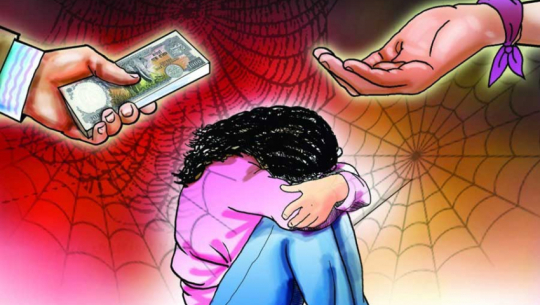
Kanchanpur: Kanchanpur district has been identified as a high-risk area for human trafficking and smuggling, with open borders creating major challenges for law enforcement.
Although Gaddachauki is the primary border point for movement into India, multiple illegal crossing routes exist in the district. According to Maheshwori Bhatta, Kanchanpur coordinator of Maiti Nepal, these unauthorized crossings have increasingly been exploited to traffic children, adolescents, and women to India, Gulf nations, and beyond.
Bhatta highlighted that poverty, unemployment, illiteracy, gender inequality, domestic violence, and entrenched social evils are key drivers of trafficking. She added that open borders, insufficient surveillance technology, lack of resources and manpower, victims’ reluctance to file complaints, delays in legal proceedings, and even the involvement of family members have worsened the situation.
“Controlling human trafficking is everyone’s shared responsibility,” Bhatta said. “Awareness, coordination, and cooperation are the foundations to stop it.” She warned that the nature of trafficking has evolved, with rising incidents of “cyber trafficking” linked to foreign employment, marriage, tourism, and misuse of technology.
“International crime networks are actively engaged,” she noted, adding that victims are often trafficked for organ trade, child labor, sexual exploitation, or criminal activities. Social activist Haridatta Bhatta stressed that human trafficking poses a grave challenge to both national and international security and human rights. She underscored the need for technology-based surveillance, school-level awareness campaigns, and legal and social rehabilitation programs.
Between July 16, 2024, and July 15, 2025, Maiti Nepal intercepted 286 people attempting to cross into India. Among them, 127 were stopped at the Gaddachauki checkpoint, 48 at the four-lane bridge, and 38 at the suspension bridge. The group included 129 children and 157 women. Of those stopped, 248 were from Sudurpaschim Province, including 136 from Kanchanpur alone.
During the same period, eight trafficking victims were rescued and repatriated from Haryana, Mumbai, Pithoragarh, Pune, Bihar, and Chamoli in India. Maiti Nepal also inspected 12,832 vehicles, counseled 46,056 people on trafficking and safe migration, facilitated family reunions for 290 individuals, and directly counseled 35 people who were then returned home.
The organization registered 180 applications for search and rescue, locating 73 people. Out of 22 domestic violence complaints, 18 were resolved, while one case of human trafficking was officially filed. To prevent trafficking, Maiti Nepal has carried out door-to-door campaigns, pamphlet distribution, legal education programs for adolescents, and community-level street plays.
Deputy Mayor of Shuklaphanta Municipality, Kalpana Pant, said widespread awareness campaigns at the village level are crucial to reducing trafficking. Similarly, Police Inspector Rajesh Basnet of Area Police Office Jhalari expressed confidence that stronger community engagement and greater coordination between government and non-governmental organizations could help reduce trafficking risks along the border.
“Strong collaboration between local, provincial, and federal governments is essential,” Bhatta stressed. “Speeding up the judicial process, creating employment through training and skill development, and ensuring digital services are necessary to combat this issue.” She added that awareness, law enforcement, stronger security, and active community campaigns remain the most effective measures against human trafficking.
Dineshkhabar Desk