Pokhara learns from Dhangadhi’s exemplary waste management practices
Gandaki: “Our city’s pride lies not in roads, bridges, or buildings, but in waste management and sanitation promotion,” said Gopi Hamal, Mayor of Dhangadhi Sub-metropolitan City, Kailali, as participants applauded his statement. Mayor Hamal emphasized that instead of merely lamenting a lack of manpower and resources, communities must adopt habits that prevent waste generation. His remarks highlighted the importance of community awareness and public participation in effective waste management.
Addressing a team from Pokhara Metropolitan City visiting to exchange knowledge on skills, technology, and best practices, Mayor Hamal stressed inter-municipal coordination. “The work being done by Pokhara can be exemplary for us, and Pokhara can also learn from Dhangadhi,” he said. “Local governments must prioritize waste management, as only a healthy and clean environment allows other activities to flourish.”
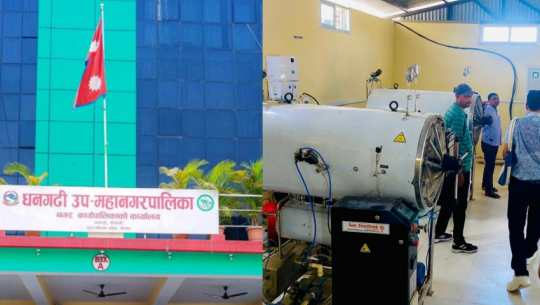
Deputy Metropolitan Mayor Hamal added that Dhangadhi is implementing a waste management and greenery promotion program under the mottos ‘Our Dhangadhi, Clean Dhangadhi’ and ‘Our Dhangadhi, We Build It.’ During the observation tour, the Pokhara team visited a biogas plant in Dhangadhi-2 Saraswati Nagar, the fine classification center for waste, and an under-construction health waste management center.
The team also observed the integrated waste management center in Dhangadhi-7 Patela, currently 80 percent complete. The Rs. 1 billion project, funded jointly by the federal government, the sub-metropolitan city, and a concessional loan from the Development Bank, is designed to manage waste for 30 years.
Ashok Awasthi, Environment Officer of Dhangadhi Sub-metropolitan City, noted that the integrated waste management center is being developed through a public-private partnership on 22 hectares. A commercial biogas plant has already begun operations with private investment. The health waste management center is being built in collaboration with Save the Children and JIZ, and fine classification and processing responsibilities have been assigned to the private sector.
During the visit, the delegation also observed Adarsh Toll and Sarvodaya Secondary School for their exemplary sanitation initiatives. The city’s greenery promotion program, including tree planting along roadsides in memory of deceased relatives, was particularly noted.
Netra Timilsina, facilitator of the Employment Creation Project in Pokhara, praised Dhangadhi’s initiatives, stating, “The investment, community campaigns, and implementation of policies and legal frameworks in Dhangadhi provide important lessons. We aim to replicate these successful practices in Pokhara.”
Timilsina emphasized the need for inter-local cooperation in waste management, creation of income-generating opportunities, and employment through proper waste management systems. Single-use plastics, including gutkha, have been banned in Dhangadhi, with arrangements to sort 95 percent of household waste for transport to the management center.
He added that changing individual behavior is critical for sustainable waste management solutions, and Dhangadhi’s model demonstrates effective school and community mobilization.
Employees of Pokhara Metropolitan City, project staff, and representatives from organizations including the United Nations Development Program participated in the observation tour, held from Monday to Friday, to exchange best practices in solid waste management.
With support from the Korea International Cooperation Agency and UNDP, the ‘Green Employment Creation Project through Recycling and Upcycling’ in Pokhara aims to promote green employment and reduce environmental pollution. The project, which began in 2024, will operate until 2029 and works to enhance community awareness on waste collection, transportation, and classification, mobilizing 136 toll organizations.