
Mushroom farming helps Kanchanpur’s Parvati Thapa achieve financial independence
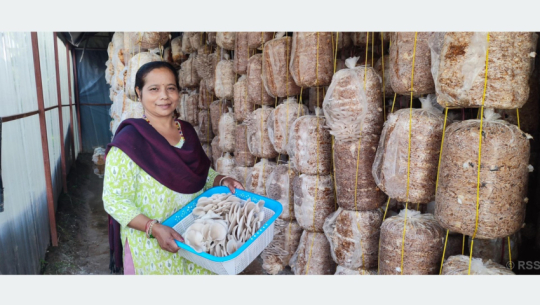
Kanchanpur: Parvati Thapa, a single woman from Vangaun in Ward No. 6 of Bhimdatta Municipality, Kanchanpur, has achieved financial self-reliance through commercial mushroom farming.
After losing her husband in 2069 BS (2012/13 AD), Thapa turned to mushroom cultivation as a way to support herself. Starting seven years ago with only basic knowledge, she now operates five farms and produces mushrooms throughout the year.
“After my husband passed away, I found myself in a position where I had to ask others for money just to get anything done. It felt terrible when they would say they didn't have any,” she recalled. “I decided that instead of asking others for money, I would do something myself to become self-reliant.”
She said the idea of mushroom farming came to her when a relative gave her some mushrooms at a time when she was determined to find a way to support herself.
“In the beginning, I didn't even know where to find the seeds (spawn),” she said. “Later, my son, who was studying agricultural science, gave me a book on mushroom farming.” She said her lack of practical knowledge initially made cultivation difficult.
Although she first tried to grow mushrooms by following the instructions in the book, she failed to achieve the expected results. “Reading a book isn't the same as doing the work yourself,” she said. “I started with five mushroom packets, but because I didn't know the proper method, the entire batch went to waste.”
She achieved a successful harvest the following year after learning cultivation techniques from the Agriculture Knowledge Center and other local mushroom farmers. Thapa said she visited farms throughout the area to learn from experienced growers, who provided valuable support.
“Initially, I had no idea how to cut the straw, how to store it, or how to boil it,” she said. As the business began generating income, she reinvested her profits each year to expand production.
According to Thapa, she earns a profit margin of approximately 50 percent after deducting investment costs. “Mushroom farming covers my household expenses and the educational costs for my two sons,” she said. “I haven't had to invest any of my own personal capital; I fund further expansion using the profits earned from sales.”
She currently sells around 1,500 kilograms of mushrooms annually, generating an income of up to Rs 200,000. Her son, who studies agricultural science, also helps her with the business. By cultivating mushrooms during both the winter and rainy seasons, she has been able to maintain year-round production and achieve financial independence.
Thapa recalled that in the early days, she grew mushrooms in a bamboo-framed shed and frequently struggled with strong winds blowing away its roof.
She later learned about a mushroom farming support program offered by the Agriculture Knowledge Center and applied for assistance. “The support from the Knowledge Center made it much easier to organize and advance my mushroom farming,” she said.
She currently produces oyster and milky mushrooms according to the season and is preparing to start cultivating button mushrooms this year.
Although she has the capacity to increase production, Thapa said the arrival of mushrooms from other areas has made it difficult to sell her produce at fair prices. She hopes to expand the business but considers market uncertainty a major obstacle.
“I had intended to significantly increase production, but mushrooms arriving from outside the district are cheaper, making it impossible to get a fair return for the effort we put into growing them,” she said. “The local government should support us by promoting local produce.”
Thapa said there is considerable potential to expand mushroom farming, but uncertainty over market prices continues to make further investment difficult.

Dineshkhabar Desk