
Three-day special education training on autism awareness concludes in Kathmandu
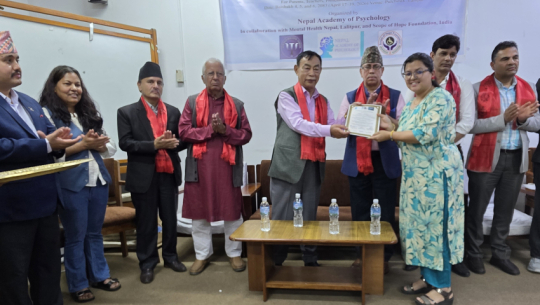
Kathmandu: A three-day ‘Special Education Training and Seminar’ focused on the practical implementation of autism awareness concluded on Monday. The program was organized by the Nepal Academy of Psychology in collaboration with Mental Health Nepal and Scope of Hope Foundation India.
Autism is a developmental condition that creates diversity in a person’s social interaction, communication skills, and behavior. It includes challenges such as difficulty in social communication, reduced eye contact, inability to understand social cues, difficulty in forming relationships, and repetitive or restricted behaviors like repeating tasks, strict adherence to routines, intense interest in specific subjects, and sensory sensitivity.
Training instructor and Director of the Nepal Academy of Psychology, Umangjung Parakram Shah, stated that autism is referred to as a “spectrum” because each individual has different symptoms and support needs. Some individuals require significant support, while others can live independently with minimal assistance. He added that no single cause has been identified, though genetic factors and differences in brain development are considered primary contributors. “Signs usually begin to appear between 6 to 12 months, and autism can be reliably identified between 18 to 24 months. According to the World Health Organization, one in every 100 children globally has autism, while in the United States, it is estimated at one in every 31 children,” he said. He noted that the rise in diagnosed cases is largely due to increased awareness, improved screening, and early detection.
Shah emphasized that autism is not a disease to be cured but a variation within human conditions. He said that an inclusive environment based on acceptance and equality, along with the removal of social barriers, enables individuals with autism to live comfortably. According to him, behavioral therapy, speech therapy, occupational therapy, special education, and other forms of support can significantly improve quality of life.
He further stated that there is a growing global perspective advocating for rights-based support for individuals with autism rather than support based on charity. In education, emphasis is increasingly placed on inclusive learning environments with adequate support rather than segregated teaching methods. He added that autism is now increasingly viewed as a form of neurodiversity rather than a problem.
At the closing ceremony, Sagarmatha Television Chairman Nirmal Gurung, social worker and political analyst Prakash Rayamajhi, Prof. Dr. Prem Kumar Khatri, Associate Prof. Dr. Aswaththamabhakta Kharel, Prof. Krishna Acharya, Dr. Rajendra Khatri, Dr. Binita Singh, autism specialist and psychologist Bhagwati Bhattarai, and banker Hari Acharya, among others, stressed the need to raise public awareness about autism.
The main trainer of the program was Bipin Maurya, a special teacher and founder of Scope of Hope Foundation, who came from Mumbai, India. The training was also conducted by Shah, Director of the Nepal Academy of Psychology and a multidisciplinary researcher in psychology, inclusive-special education, and political science.

Dineshkhabar Desk