Election talk over tea dominates public discourse in Kanchanpur
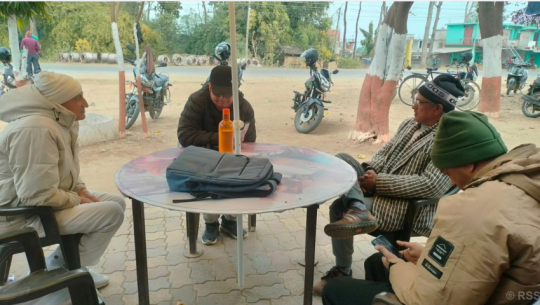
Kanchanpur: Every day, lively discussions about the upcoming elections unfold over cups of tea at a tea shop near Bansamiti Bazaar in Shuklaphanta Municipality-5, Kanchanpur.
Listening to those gathered, it appears that many come less for tea and more to debate elections. Teachers, employees, politicians and prominent local citizens regularly participate in these conversations, each offering their own analysis. Some believe elections will be held, while others doubt it. Despite differing arguments, suspicions and opinions, there is a common conclusion: there is no alternative to elections.
Shivi Luhar, a local leader of the Nepali Communist Party who is frequently seen at the tea shop, described elections as a beautiful aspect of democracy and said they are the only way to address the current situation. He expressed some concerns, stating, “It is not enough for the government to just announce the date; it is equally necessary to take all political parties into confidence and ensure security.”
Many agree with his view that regular elections are essential to institutionalize democracy and the federal democratic republic established by the Constitution of Nepal. At the same time, there is a shared understanding that the current political situation has created doubts and dilemmas among the public. “Elections value public opinion. Our party is expanding its organization up to the ward level and holding unity meetings in preparation for the elections,” Luhar said, adding, “But the government should not delay in creating a solid basis and environment for elections to be held on time. Parties that seem to disagree on some issues should also focus on creating an electoral atmosphere.”
Dan Singh Air, president of the Nepali Congress Shuklaphanta Municipal Working Committee, expressed some uncertainty due to the issue of parliament restoration being under consideration in court. However, he said the party is preparing for elections, having already initiated internal processes such as membership renewal and candidate recommendations. “In a democracy, elections are the only way to reach the people,” Air said. “Since time is short, the government should move forward by including all parties.”
Krishna Baijanath Multipurpose Campus Principal Bhavaraj Niraula also joined the discussion, stating that elections would inject new energy into the effective implementation of federalism. He emphasized the need to prioritize technical preparations. “Voter education should have already started, but it does not seem to have happened yet. There is confusion due to the lack of concrete progress in mobilizing security personnel and deploying employees for the voting process. We must move forward,” he said.
Political expert Tek Bahadur Hamal also views elections as a means to further strengthen democracy and federalism. “There has been talk of elections externally, but doubts still persist among some,” he said. “The need of the hour is to ensure an electoral environment by taking all parties into confidence. Elections should be seen as a foundation for consolidating the achievements made so far.”
While debates over parliament restoration or elections continue within constitutional and legal processes, Hamal stressed that public opinion remains the backbone of democracy. “A clean, fair and rigged election is the only way to further strengthen the federal system and find a political solution,” he said.
Most participants in the discussions emphasized that political parties are the main stakeholders in a democratic election. They stressed that the government should break the cycle of suspicion by involving all parties in the electoral process.
“The government should take political parties into confidence and create an environment for elections, while parties should take the initiative to prepare citizens for voting by committing to fulfill their aspirations for change. This is the need of the hour and the solution to the country’s current situation,” many concluded.