
Tharu community in Kailali celebrates Bhajahar with song, worship, and togetherness
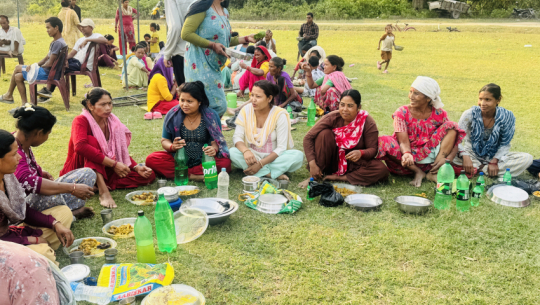
Kailali: The Tharu community of Ghodaghodi Municipality-3, Narayanpur, came together in vibrant celebration of Bhajahar, one of the most significant traditional worships observed by the Tharu people. On Monday, 171 families gathered in an open field, spending the day worshipping, cooking, eating, singing, and enjoying the festivities before returning home late in the evening.
Nearby, Tharu singers Sukmaiya and Ramlal Chaudhary performed the traditional song Sajana, while others prepared and distributed food, adding to the communal spirit. A similar celebration had recently taken place in Ek Shrashtinagar of Ghodaghodi Municipality, where the community also enjoyed Bhajahar in the open field.
Bhajahar is currently being celebrated across the Tharu communities of Kailali and Kanchanpur, with different villages observing the ritual on different days. According to Aman Chaudhary, Secretary of the Ghodaghodi Municipality's Municipal Bhalmansa Committee, all villages in the municipality will observe Bhajahar by Baisakh 20.
"This festival, celebrated during the month of Baisakh, is one of the Tharu community’s major religious events," said Budhram Chaudhary, Municipal Bhalmansa. Alongside Bhajahar, the Tharu people also perform Lawangi and Harhar Puja, which are associated with food crops. Bhajahar, in particular, is believed to protect communities from diseases as the summer season begins.
On the day of Bhajahar, the Guruva (village priest) performs morning worship of Nava Durga. Budhram Chaudhary explained that there is a tradition of sacrificing animals and birds to appease the goddess, including the ritual where the Guruva cuts his tongue and offers blood to Durga. This act is believed to prevent epidemics and protect the community.
Villagers contribute money to collectively purchase animals such as sheep, goats, pigs, and chickens for sacrifice. Guruva Pancharam Chaudhary emphasized that Bhajahar brings peace, happiness, and protection from illness. "In the past, Bhajahar was celebrated for up to nine days," he said. "Today, it's usually limited to one day, though some communities continue to observe it over two-and-a-half, three, or five days."
The Legend Behind Bhajahar
Dr. Ram Prasad Chaudhary, a scholar of Tharu culture, shared that while various interpretations exist regarding the origins of Bhajahar, one prominent legend connects it to the Ramayana. According to him, after Ram rescues Ayodhya from Ravana and sends pregnant Sita into exile, the people of Ayodhya offer her food outside their homes. This tradition is believed to be the root of Bhajahar in the Tharu community.
Over time, Durga worship by Gurus has become an integral part of the Bhajahar ritual, blending with the ancient story of Sita. The practice is especially meaningful during the summer, when communities are vulnerable to diseases and epidemics.
Each village has a Guru responsible for conducting rituals, offering protection from supernatural harms, and healing during outbreaks. "If Bhajahar is not performed properly, it is believed that disaster will strike," said Sitabi Katharia, the Bhalmansa of Ghodaghodi Municipality Ward No. 3. "Bhajahar is also seen as a way to ensure women's happiness, which is believed to bring harmony to families and the wider community."
Sudhiya Devi Chaudhary, a Bhajahar participant from the same ward, shared how the festival fosters unity. “Everyone gathers, shares their joys and sorrows, cooks and eats together, dances and sings, and enjoys the day, even sleeping under the open sky,” she said.
Bhajahar provides a rare opportunity for women—often occupied with household and farming responsibilities—to come together, celebrate, and connect with one another in a communal space.