
Rediscovery of small-clawed otter in Nepal after 185 years
A small-clawed otter chick was found at the confluence of Rangunkhola and Puntarakhola in Dadeldhura.
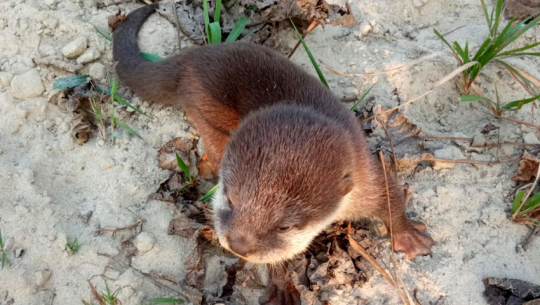
Dhangadhi: The Asian small-clawed otter, which was long suspected to be extinct in Nepal, has been rediscovered in the Far West Province after 185 years. The species was found at the confluence of Rangunkhola and Puntarakhola in Dadeldhura. This otter had not been seen in Nepal since 1839, and due to the prolonged absence of any sightings or concrete evidence, it was believed to have vanished from the region.
The recent discovery of this species in Dadeldhura confirms that the small-clawed otter still exists in Nepal. According to Rajiv Chaudhary, Forest Officer at the Divisional Forest Office in Dadeldhura, locals captured a small otter cub from the confluence of the Rangoon and Puntarakhola rivers in November 2024. "After receiving the information, we rescued the cub, nurtured it for a few days, and then released it back into its natural habitat," he said. "I also documented the species through photographs and shared them with experts for identification."
A team comprising Mohan Bikram Shrestha, Ganga Shrestha, Hirulal Dangaura, Rajiv Chaudhary, Purnaman Shrestha, Karun Dewan, Rajesh Sada, Melissa Savage, and Zuofu Xiang has verified that the species is indeed a small-clawed otter. Their collaborative research, along with photographic evidence of the rediscovery, has been published in the International Union for Conservation of Nature (IUCN)'s SSC Otter Specialist Group Bulletin.
Forest Officer Chaudhary stated that a population of small-clawed otters exists at the confluence of the Rangoon and Puntarakhola rivers. "Locals have frequently spotted groups of small otters in the area," he said. "The cubs that were caught came from one such group." The presence of young otters at the site further supports the existence of a breeding population in the region, as highlighted in the IUCN journal. The published study also emphasizes the urgent need for further research and conservation efforts.
Previously, small-clawed otters, which inhabit both the Terai and hill regions of Nepal, were believed to exist only within protected park areas due to habitat destruction. This new record, however, confirms their presence outside these conservation zones. These otters play a crucial role in the ecosystem, as they are semi-aquatic and depend on water sources for sustenance. They primarily feed on fish, but they are also known to consume crabs, shrimp, and snails. Additionally, their presence is indicative of clean water and a noise-free environment.
Researcher Hirulal Dangaura stated that small-clawed otters were found in an area characterized by rocky slopes, flowing water, and nearby forests in Dadeldhura. "This region has minimal human activity, making it a suitable habitat for small otters," he said. "The secluded nature of the area provides a safe environment for their survival."
Habitat Destruction Poses a Major Threat
Nepal is home to three otter species: the black otter, the brown otter, and the small-clawed otter. Their survival is increasingly threatened by habitat destruction. According to researcher Dangaura, the excavation of stones, gravel, and sand from riverbeds poses a significant risk to these animals. "Habitat destruction is the primary challenge facing otters," he said. "Additionally, human activities such as hunting and trapping have contributed to the decline of their population."
The rediscovery of the small-clawed otter in Nepal marks a crucial moment for conservationists, highlighting the need for immediate action to protect and preserve this rare species.

Dineshkhabar Desk