Bhatta departs after collaborating with 24 ministers and three prime ministers
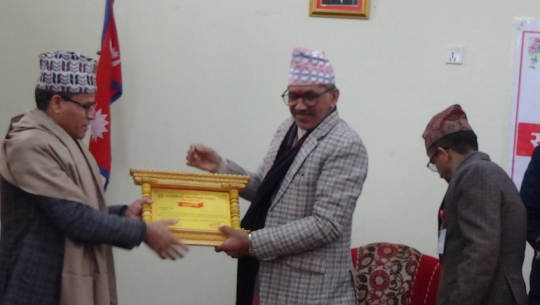
Dhangadhi: Former Chief Minister Trilochan Bhatta took the oath of office and secrecy on 5th Fagun 2074. With the support of CPN-UML, the first provincial government was formed under the leadership of Trilochan Bhatta, a member of the provincial assembly who won from the CPN-Maoist Center. Although the chief ministers of other provinces have changed, the chief ministers of Madhes and Sudurpaschim provinces have had the opportunity to complete their five-year term. Outgoing Chief Minister Bhatta has said that he was able to complete his five-year term with everyone's help.
"With everyone's help, I was able to work for the entire term," he said, "I had the opportunity to work with the support of 25 ministers, 53 provincial assembly members and the central and provincial leadership of all parties. I want to thank everyone."
Although there was no change in the leadership of the government in Far-West, the process of changing the ministers in the government continued. The outgoing Chief Minister Bhatta got the opportunity to lead the coalition government of first two parties (NCP UML and CPN Maoist), then one party (NCP) and finally three parties CPN Maoist Center, Nepali Congress and CPN Samajwadi). Bhatta faced two no-confidence motions but easily won a vote of confidence from the state assembly. CPN-UML leader and former minister Prakash Bahadur Shah said that Chief Minister Bhatta led the provincial government efficiently for five years.
"The former chief minister has led the state government in a controversy-free manner," he said, "he has completed his term without getting into any controversy."
The former Chief Minister has said that the government under his leadership has laid the foundation of federalism. In the first phase, Bhatta got the opportunity to run the government with his fellow opposition and the main opposition. The former chief minister and ministers have said that the 24 ministers, 53 MPs, chief secretary and secretaries and employees who participated in the government made it easy to work. Dr. Ran Bahadur Rawal, a former minister and Congress leader, said that while working as the leader and minister of the main opposition party with the former Chief Minister Bhatta, he has moved forward by cooperating.
"Initially, I got the opportunity to work as a leader of the main opposition party and later as a minister in the government," he said. We have laid the foundations of the provincial assembly and the government. We should be happy about it.
Former Chief Minister Bhatta had the opportunity to work with four state chiefs. During his tenure, Mohanraj Malla, Sharmila Kumari Pant, Gangaprasad Chaudhary and Devraj Joshi were given the responsibility of state chiefs. Similarly, Bhatta had the opportunity to collaborate with 3 Prime Ministers. Bhatta said that it was an opportunity to work with KP Sharma Oli, Sher Bahadur Deuba and Pushpa Kamal Dahal.
Who are the 24 people who became ministers under Bhatta's leadership?
Former Chief Minister Trilochan Bhatta had the opportunity to collaborate with 24 ministers. All the parties represented in the provincial assembly had to give a vote of confidence to Bhatta. At the end of the tenure, CPN-UML became the main opposition party, while the main opposition Nepali Congress became a partner in power.
In the Far-West government led by Bhatta, Dirgh Bahadur Sodari and Prakash Rawal got the opportunity to become ministers again. Both of them are the leaders of CPN United Samajwadi party formed by the split of CPN UML. Now both of them have been directly elected for the second term from the same party.
Similarly, Dr. Ran Bahadur Rawal, Govindraj Bohara of Nepali Congresses became the Minister and Tek Bahadur Raka became the Minister of State. In 2074, Jhapat Rawal, who became the Minister of Economic Affairs from the Maoists, decided to leave the ministerial post and join the CPN-UML when the CPN split. Binitadevi Chaudhary from the CPN Maoist center got the opportunity to become a minister for the full term, while Manavhadur Dhami also became a minister. Maoist's Man Bahadur Sunar became the Minister of State.
Under Bhatta's leadership, Prakash Bahadur Shah became a minister twice from CPN-UML. Similarly, UML's Pathansinh Bohara, Krishnaraj Subedi and Tara Lama Tamang ministers and Kulbir Chaudhary and Archana Gahatraj got the opportunity to become state ministers. Although Maya Bhatta was a minister from UML, she joined the Samajwadi party when the party split. Similarly, Tara Lama Tamang, Kulbir Chaudhary, Maya Tamang Bohra left the Socialists and returned to UML after the local elections.
The largest number of provincial assembly members of the CPN United Samajwadi Party, formed by the split of the CPN-UML, had the opportunity to become ministers. Like Dirgh Bahadur Sodari and Prakash Rawal, Purna Joshi, Lal Bahadur Khadka became a minister from Samajwadi, while Sushila Budhathoki, Chunkumari Chaudhary, Manakumari Saund, Bal Bahadur Sodari, Amar Bahadur Saund and Maya Tamang Bohra got the opportunity to become state ministers.
Dineshkhabar Desk