Ownership conflicts hinder wetland conservation in Kailali
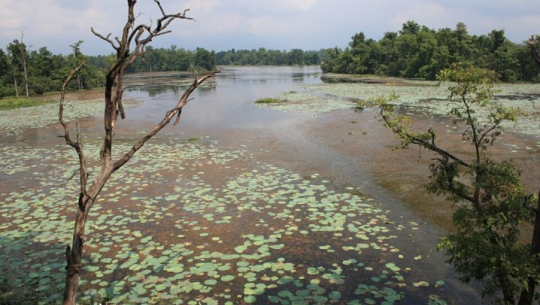
Ghodaghodi (Kailali): Rajkumar Chaudhary, chairman of Om Shanti Community Forest in Bhajani Municipality-9, Kailali, has been entangled in legal disputes for over a year. Elected by villagers to lead the community forest, Chaudhary and fellow members Foniram, Ramsagar, Manoj, and Sheetal Chaudhary are now involved in court cases over Ghortal, a 37-hectare lake within the forest. The municipality had earlier awarded a fish farming contract to Prem Bahadur Bhul of Lamkichuha-1. After the contract expired in mid-Chait 2080, the community forest users’ group decided to manage the lake independently.
The group, including Chaudhary, filed a case in the Kailali District Court claiming that the contractor had damaged the fish they had raised, demanding compensation of Rs. 17 million. “As soon as we knew the contract had expired, we began stocking the lake with fish,” said Chaudhary. He added that the contractor had sold the existing fish and dried up the lake. However, the municipality later extended the contract on April 20, 2081, without resolving previous dues, prompting the contractor to file a Rs. 17 million case against the group. Chaudhary noted that while attempting to restore community rights and protect the lake, they have faced personal lawsuits worth crores.
Other lakes in Kailali are facing similar ownership conflicts. These disputes have hampered proper protection, led to unpaid contractor dues, contract cancellations, and resistance from local communities. Traditional uses like irrigation and the Tharu community’s harvesting of fish and snails, alongside commercial fishing, have further complicated biodiversity conservation and environmental management.
Ownership disputes extend beyond Ghortal. The 5.57-hectare Lotihua Lake in Bhajani Municipality-2 reached court in 2075 BS when Hariram Chaudhary filed on behalf of the community forest users. The court ruled in 2076 BS that the lake falls under municipal jurisdiction per the Local Government Operation Act 2074 BS. Despite this, the community forest continues to manage and protect the lake. Similarly, the Laukah Bhaukah Lake in Bhajani-4 Bijulia saw a mediated agreement: the municipality would contract for fish farming, giving 50 percent of the income to the community forest users group for development. However, the group claims they have yet to receive the agreed funds. Mayor Kewal Chaudhary acknowledged that although the court ruled on two lakes, disputes remain unresolved and the municipality is seeking coordination with community forests to find solutions.
Koilahi Lake in Kailari Rural Municipality, spanning over 67 hectares, has also been a point of contention. Transferred to a community forest in 2073 BS, the lake was managed by the Koilahi Lake Conservation and Related Activities Committee. Complaints of misappropriated funds were investigated and resolved, but disputes resurfaced. Agreements were made to jointly manage the lake and contract revenues, though conflicts over fund management persist. Kailari Rural Municipality is now working to bring over fifty lakes under a one-door system to streamline management.
Ownership disputes are widespread across Kailali. In Bhajani Municipality-9, Sonia Rupiya Nukli Lake is under community forest management despite municipal bids for contracts. The lake, covering more than 37 hectares, generates over Rs. 1.1 million annually. Community forest chairman Suresh Chaudhary asserted that the forest will continue management and is willing to share income, but ownership must remain with the forest. Other municipalities, such as Gauriganga and Ghodaghodi, have seen similar disputes, with lakes returning to community forest control after conflicts.
Financial losses have also resulted from these conflicts. Bhajani Municipality, after acquiring over 20 lakes, has struggled to collect more than Rs. 40 million in arrears as of fiscal year 2080/81, with only nine lakes currently under contract. Kailari Rural Municipality faces similar issues, with Rs. 19.2 million in arrears from over 15 lakes. While regulations allow for recovery of dues with interest, collection has been slow.
The root cause of these conflicts lies in legal ambiguity. Most lakes fall within community forests, but overlapping claims arise due to contradictions between the Constitution, the Forest Act 2076, and the Local Government Operation Act 2074. The Constitution assigns national forests to provincial government jurisdiction, while the Forest Act defines forest areas, including ponds and lakes, and provides for their transfer to community forests. The Local Government Operation Act grants local levels rights to manage wetlands, creating dual claims. The National Wetlands Policy 2059 BS emphasizes equitable, community-based wetland management.
This legal ambiguity has resulted in lakes and wetlands being simultaneously managed by community forest user groups and contracted by municipalities for commercial fisheries. Commercial use challenges biodiversity conservation, while legal management responsibilities create ongoing conflicts. The Basanta Corridor municipalities, particularly Bhajani and Kailari Rural Municipality, face major conservation, utilization, and management challenges due to unresolved ownership, contractual disputes, and uncollected dues.
Yagya Prasad Dahal, former Joint Secretary at the Ministry of Forests and Environment, stresses that resolving these disputes requires a clear legal framework, policy coordination, and practical cooperation among federal, provincial, and local governments. He noted that the conflict between the Forest Act 2076 and Local Government Operation Act 2074, despite clarification from the National Wetlands Policy 2069, persists. “This problem will be solved in the long term only if the federal government assigns ownership of ponds within community forests to a single entity through a legal amendment,” Dahal said.

Dineshkhabar Desk