
Monkey menace leaves Baitadi farmlands barren, farmers abandon agriculture
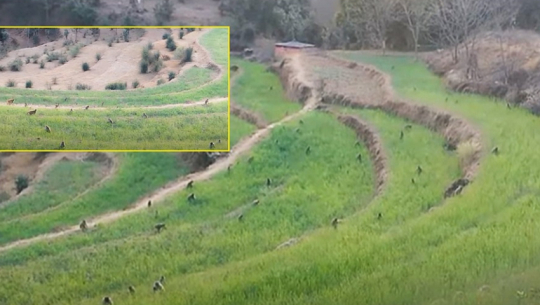
Baitadi: Farmlands across villages and settlements in Baitadi, once lush and productive, are gradually turning barren due to the growing menace of monkeys. Farmers have become discouraged from cultivating crops as monkeys increasingly invade fields from morning to evening, destroying produce.
Locals say that their interest in agriculture has declined as monkeys damage crops before they ripen, despite months of hard work. With the problem spreading across most villages in the district, cultivable land is increasingly being left unused.
According to Dilaram Bhatta of Dasharathchand Municipality-4, farmlands around Gothalapani, the district headquarters, which were once filled with fruits, vegetables and grains, are now becoming barren. “Monkeys destroy crops when they are planted, and they cannot be saved even after they are ripe,” he said.
Similarly, Nirmala Bhatta of Patan Municipality-3 said the monkey menace has significantly altered village life. Of her 18 ropani land, most now remain uncultivated. “Earlier, five to six lots of maize were grown in a season, but I have stopped planting maize for four years,” she said.
Locals report that monkeys begin destroying crops as soon as they start growing—uprooting plants, tearing stalks and ruining ripe fruits. Farmers face further challenges as monkeys often damage crops even when they do not consume them. Families are forced to take turns guarding their fields to prevent losses.
Narendra Dhami of Surnaya Rural Municipality-3 said many farmers have abandoned cultivation altogether as losses outweigh production. Monkeys have been destroying not only maize, millet and rice but also garlic, onion, peach, ghirau and chichinda.
In local levels including Dogadakedar, Shivnath, Surnaya, Pancheshwor, Melauli, Patan and Dasharathchand, the rate of farmland turning barren is increasing. Locals estimate that around 1,200 households have been forced to leave the village due to their inability to sustain farming.
According to Lokraj Bhatta, ward chairman of Melauli Municipality-9, farmers are now shifting toward crops that are less vulnerable to monkey attacks. As it has become difficult to protect maize, millet and vegetables, many are turning to haldo farming.
The problem has also extended beyond crops, with monkeys increasingly attacking humans. Locals report incidents of bites while trying to chase them away, and in some cases, monkeys have even taken maize stored inside homes.
Residents say that monkeys, once seen occasionally, are now appearing in large groups. Stakeholders believe the issue has worsened due to expanding forest areas, migration from villages and increased availability of food sources near settlements.
The decline in agricultural production due to the monkey menace is affecting both the local economy and food security. Despite repeated demands from locals for an effective control plan, no concrete measures have been implemented so far. Public representatives say discussions are ongoing as complaints continue to emerge from different wards.
The rapid transformation of Baitadi’s once-green farmlands into barren land has become a serious concern for the district’s agricultural sector.
From Gorkhapatra

Dineshkhabar Desk