Rana Tharu community in Far-west celebrates Khakhadehara festival, marking conclusion of month-long Holi
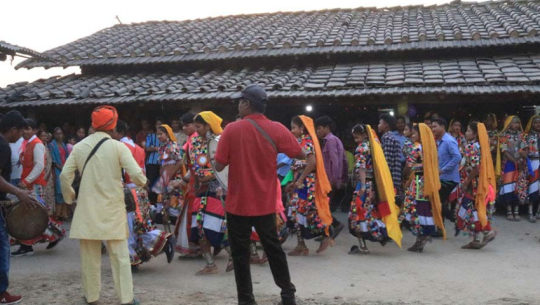
Kanchanpur: The Rana Tharu community living in Kailali and Kanchanpur districts of the Far West are formally bidding farewell to this year's Holi by celebrating the traditional Khakhadehara festival today. The Holi of the Rana Tharu community, which is celebrated continuously for more than a month, has a tradition of ending with the Khakhadehara festival.
Holi in the Rana Tharu community is not limited to just a festival of playing colors. This festival is celebrated as a celebration deeply connected to social, religious and cultural life. Considered the biggest and most important festival of the year, Holi is also regarded as a symbol of collective unity, cultural continuity and religious faith for the community.
The Holi festival in the Rana Tharu community begins on the day of Magh Shukla Purnima. On that day, the festival is inaugurated by setting up ‘Hori’ in the village. After that, Holi is played only at night for about a month. This period is known as ‘Jiwandu Holi’ in the Rana Tharu community.
During the days of Jiwandu Holi, it is customary for women and men of the village to gather throughout the night to sing traditional Holi songs, dance and present religious stories through songs. Ramsahay Rana says that it is believed that this not only entertains the community but also strengthens religious faith and cultural awareness.
According to him, on the day of Falgun Purnima, the Holika set up in the southeast direction of the village is ritually burned. The next day after the Holika burning is called ‘Tika’. On this day, everyone in the village has a tradition of applying tika with the ashes left after burning Holi. According to the belief in the community, applying tika with the ashes of Holi is believed to prevent diseases, improve health and achieve longevity, says local Ramsahay.
From the day of Tika, it is customary to play ‘Mari Hori’ or ‘Dead Holi’ for eight days. During this period, Holi is played both day and night. On the eighth day of Dead Holi, the Khakhadehara festival is celebrated, which is considered the formal conclusion of Holi.
Special preparations begin in the village early in the morning on the day of the Khakhadehara festival. Village leaders, valmansa, servants and other responsible persons go to every house and collect puja materials. The puja materials include seven types of grains, clay pots, pieces of khapta, jugs, lotas, kandi made from dried cow dung, lamps, clay horse statues and pure water.
According to Ratanlal Rana, a local of Kasraul, Shuklaphanta Municipality-6, these materials are collectively called ‘Satna’. “Materials are collected from all the houses in the village, which shows that this festival is based on collective participation,” he says.
The collected materials are taken to the village square or a specific place and worshipped according to traditional rituals. After the puja is completed, it is customary to break the clay pots, khapta, horse statues, lamps, bones and other materials. Jagata Rana, a leader of the Rana Tharu community, said that it is a tradition for only certain people in the village to break the Khakhadehara. “This act is symbolically considered a ritual to remove negative energy from the village,” he said.
According to him, the community believes that this festival will drive away demonic tendencies, diseases, misfortune and other negative influences from the village. After breaking the Khakhadehara, the participants return to the village. There is a strong belief that one should not look back while returning. According to the elders of the Rana Tharu community, there is a belief that if one looks back, misfortune will come or evil forces will appear.
Another important aspect of the Khakhadehara festival is the tradition of asking for ‘phaguwa’. After the puja is completed, the youth and leaders of the village go door to door and ask for phaguwa. In the form of phaguwa, the householder gives cash, food or other materials according to the amount. The money collected in this way is used to organize a group feast, dance and cultural programs.
In the evening, a festive atmosphere is seen in the village. Both men and women dress up in traditional costumes and adornments and play Holi, sing songs and dance. According to the beliefs of the community, the worship and rituals performed during the Khakhadehara festival are believed to improve the crop, eliminate diseases, and bring prosperity to the village.
Kriparam Rana, former central president of the Nepal Rana Tharu Society, said that Holi is the most important festival for the Rana Tharu community. “Holi has special importance in the cultural life of the Rana Tharu community,” he said, “The Khakhadehara festival in particular works to strengthen the unity, culture, and traditions of the community.”
According to him, it is customary to stop farming and driving bullock carts in the village on the days of the Khakhadehara festival. He mentioned that the community, which has been battling malaria, epidemics, and natural disasters in the Terai region in the past, has developed such cultural traditions to maintain social unity.
Since the possibility of diseases spreading is higher during the hot season, which begins with the onset of summer, the community believes that the Khakhadehara festival will symbolically remove ghosts, diseases, and misfortune from the village. Thus, the Khakhadehara festival has become not just a religious ritual but an important practice to preserve the social unity, cultural identity and traditional values of the community.
“This festival, which has been celebrated continuously for centuries, has played an important role in keeping the original culture, traditions and social life of the Rana Tharu community alive to this day,” said former chairman Rana. The Sudurpaschim provincial government has declared a public holiday on the occasion of the Khakhadehara festival today.
Dineshkhabar Desk