
Rice production in Far-west province rises despite shrinking cultivation area
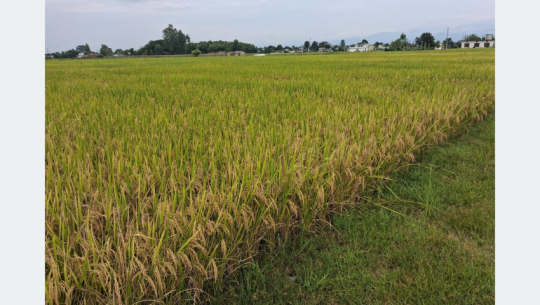
Dodhara Chandani (Kanchanpur): Rice production in the Far West Province has increased in recent years despite a reduction in the cultivation area, thanks to improved farming techniques and the adoption of professional agricultural practices.
According to statistics from the Directorate of Agricultural Development, Far West, in the fiscal year 2079/80, 648,924 metric tons of rice were produced on 183,317 hectares, with a productivity of 3.54 metric tons per hectare. In the same year, wheat was produced on 144,582 hectares yielding 331,920 metric tons, maize on 50,607 hectares yielding 144,250 metric tons, and millet on 17,112 hectares yielding 19,472 metric tons, with productivity of 2.29, 2.06, and 1.14 respectively.
In fiscal year 2080/81, despite a decrease of 4,242 hectares in rice cultivation area, production increased to 672,928 metric tons with a productivity of 3.76 per hectare. Wheat production rose to 328,069 metric tons on 139,732 hectares with a productivity of 2.35. Maize production increased to 106,997 metric tons on 49,258 hectares with a productivity of 2.17. By 2082/83, rice cultivation area declined further to 177,230 hectares, but productivity increased to 3.88 per hectare, resulting in a production of 686,887 metric tons.
Keshav Raj Pandey, Information Officer of the Directorate, highlighted that districts like Kailali and Kanchanpur lead in production. “Production and productivity have increased every year due to improved farming methods and advanced seed varieties. The government has also been providing seeds at a 50 percent subsidy,” he said. The use of organic fertilizers, better irrigation, government support, and technical guidance have further boosted yields.
In Kanchanpur, rice productivity reaches 4.6 metric tons per hectare, while in Kailali it is 4.5 metric tons per hectare. Dharma Bahadur Saud, Information Officer at the Agricultural Knowledge Center, emphasized the role of irrigation in enhancing production. “We provide small-scale irrigation facilities under subsidy in areas lacking proper irrigation. Last year, 776 tube wells were installed across nine local levels,” he said. Currently, irrigation covers 39,650 hectares in Kanchanpur, supplemented by 11,600 hectares from the Mahakali Irrigation Project’s first and second phases.
Kailali and Kanchanpur, often referred to as the granaries of the Far West, supply food even to remote hilly districts, demonstrating how modern farming practices and government support are transforming agriculture in the region.