Local Levels Urged to Implement Sixth National Action Plan on Human Rights
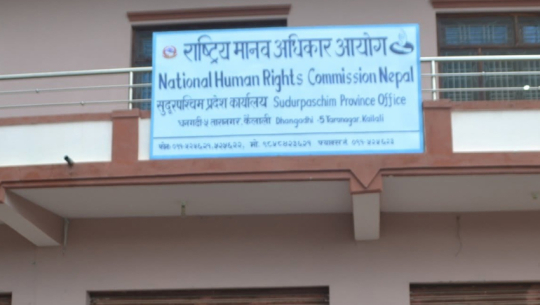
Far West: The National Human Rights Commission, Far West Province Office, has urged all local levels to actively implement the Sixth National Action Plan on Human Rights.
The office has issued a circular to the chiefs/chairpersons and chief administrative officers of all 88 local levels in the province, urging them to form local-level coordination committees as prescribed by the action plan and proceed with its implementation.
The Government of Nepal’s Council of Ministers approved and brought the Sixth National Action Plan on Human Rights (2083/84–2087/88) into implementation on Ashad 24. The plan clearly assigns responsibility for the protection and promotion of human rights not only to the federal government but also to provincial and local governments, said Prakash Bhatta, Head of the Commission’s Province Office.
He said local levels have been urged to make development plans and service delivery human rights-friendly through institutional mechanisms.
“A human rights-based approach sees development not just as infrastructure construction or service expansion, but as a process of ensuring citizens’ rights. On this basis, while formulating policies, plans, budgets and programs, the question of who has received services, who has been left out, why has been left out, and how to bring the backward communities into the mainstream should be kept at the center,” Bhatta said.
The action plan identifies the provincial government as the responsible body for about 122 activities and local levels for 101 activities. Among these responsibilities, 17 priority areas have been identified, including education, health, food and housing rights, labor and social security, women’s and children’s rights, environment, justice administration, human trafficking control, social inclusion and digital rights.
“The action plan has made human rights a part of the regular work performance of the provincial and local governments, not a limited subject of the human rights office or commission. A situation has arisen where the quality and accessibility of services provided to citizens by the local level must be evaluated from the perspective of human rights. It is an obligatory duty to comply with it. We have already started taking initiatives on our part,” Bhatta said.
According to Human Rights Officer Daibagya Raj Neupane, a human rights-based development approach considers equal access to development benefits, non-discrimination, participation, accountability, equality and empowerment as important foundations. He said the participation of target groups, equality in budget allocation, identification of groups deprived of services and their meaningful participation in decision-making should be ensured during planning.
“This approach sees citizens not only as service recipients but also as the main beneficiaries of rights. It establishes the local government as the responsibility bearer of fulfilling the rights of citizens. This makes transparency, accountability and citizen participation mandatory in service delivery. We are reminding the local level in writing to comply with the same,” he said.
The Commission has urged local levels to form coordination committees for implementing the action plan, coordinate with concerned branches and wards, review the human rights situation, and prepare semi-annual and annual progress reports. The Commission believes these measures will help link the action plan with the regular planning, monitoring and evaluation systems of local governments rather than limiting it to documents.
On Bhadra 2, the Commission issued a circular to all local levels in the province, drawing their attention to the provision under section 4.2.4 of the action plan regarding the formation of local-level coordination committees. It requested information within 15 days on initiatives taken to implement the relevant provisions.
Earlier, on Shrawan 20, the Commission had requested local levels to submit within seven days details on the human rights situation of indigenous peoples, protection and development of language, culture and fine arts at the local level, including relevant policies, laws and standards.
Similarly, the Commission has urged local levels to link the question of whether there has been real improvement in the rights, participation and access of women, Dalits, children, persons with disabilities, senior citizens, marginalized and at-risk communities with the result indicators.
The action plan provides for coordination committees under the coordination of the Chief Secretary at the federal level, the Chief Secretary at the provincial level, the District Coordination Committee chief at the district level and the chief or chairperson at the local level. The plan emphasizes building institutional structures, strengthening their capacity and effectiveness, improving policies and laws, and providing services that citizens can directly experience. A timeframe and result indicators have been set for each activity.
The Commission has therefore stated that provincial and local levels should now assess how much of the responsibilities specified in the action plan have been fulfilled and what citizens have gained from them, rather than simply assessing whether human rights-related programs have been conducted.
Bhatta said that since the observance, protection and promotion of human rights are also linked to the image and dignity of the nation, all concerned should take the implementation of the action plan seriously.

Dineshkhabar Desk