Social Security in Nepal: Coverage gaps persist as responsibility remains diffused
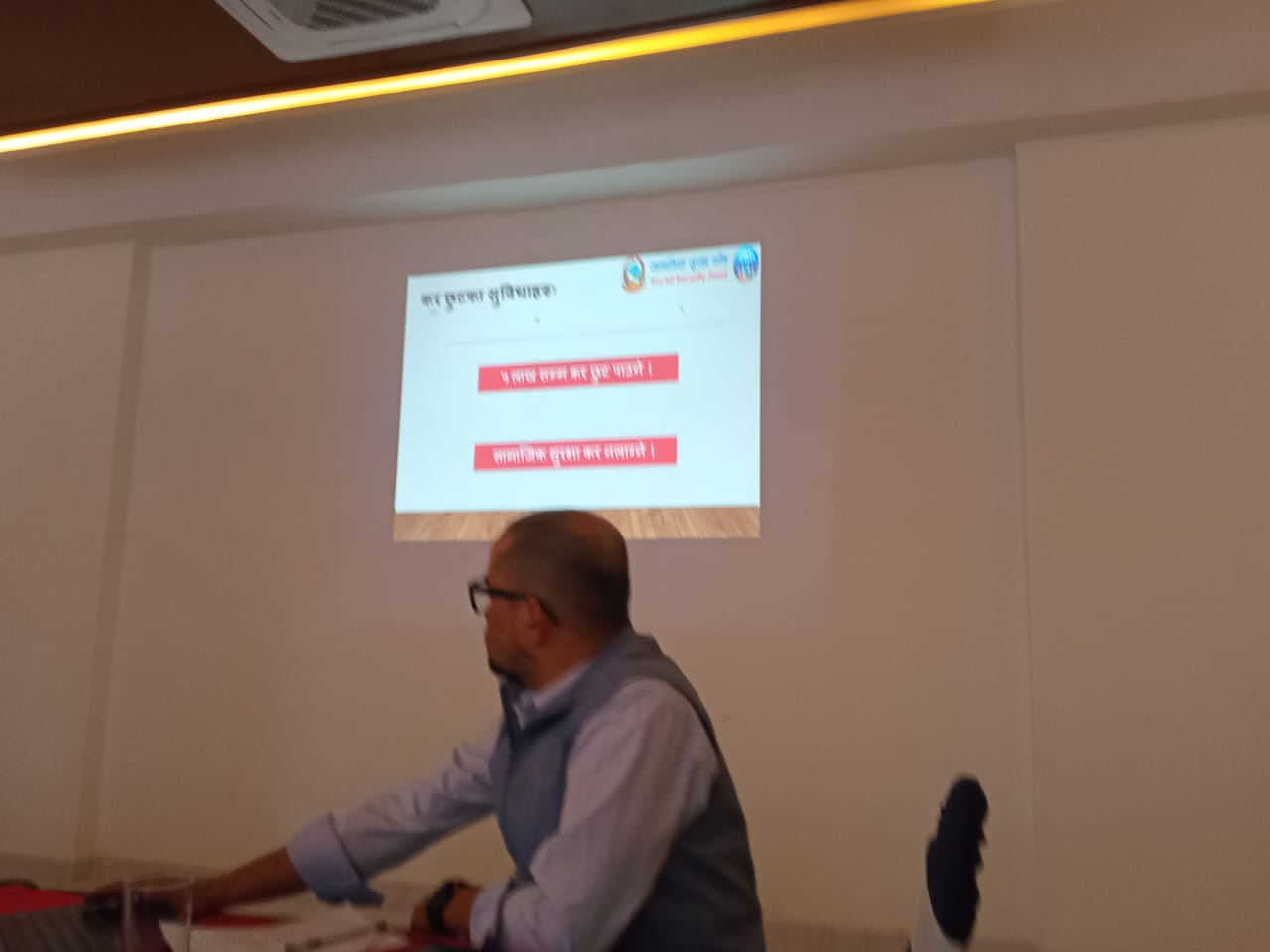
Dhangadhi, November 21, 2025: A Capacity Building Program on Social Security for media personnel was held yesterday at Siddharth Hotel, Dhangadhi Chaura, organized jointly by ILO Nepal’s Dhangadhi office and the Social Security Fund (SSF), Nepal. The program highlighted the challenges in extending social protection to informal workers, women, and marginalized communities, while exposing the accountability gaps across federal, provincial, and local governments.
Informal Work and Social Inequality
Nepal’s labor market remains overwhelmingly informal: approximately 90% of workers operate outside formal employment, with only a small fraction of women employed formally. Workers from marginalized communities, particularly Dalits from the Tarai region, are largely concentrated in the informal sector. Agricultural laborers, daily wage workers, and other labor classes remain unprotected despite constitutional guarantees under Article 34, which ensures social protection for all workers.
Speakers at the program emphasized that poverty and informal work are strongly correlated, and that most informal workers lack access to universal health coverage, retirement savings, and other social security benefits.
SS Fund: Coverage, Contributions, and Benefits
The Social Security Fund (SSF) follows an inclusive model inspired by ILO Convention 102, including four sub-schemes: medical/maternity, accident & disability, dependent family protection, and old-age pension. Key facts:
• Contribution Structure: Formal sector employees contribute 11% of their basic salary, while employers contribute 20%, totaling 31%. Informal and self-employed workers have similar contribution frameworks but participation is low.
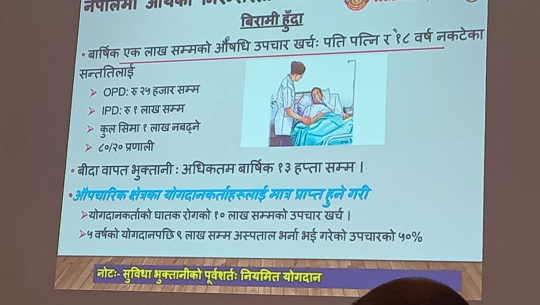
• Benefits: SSF provides up to NPR 100,000 for medical treatment, NPR 700,000 for accident coverage, maternity leave, family protection, and old-age pensions. Over 15.75 billion NPR has been disbursed in claims to date, covering more than 756,000 beneficiaries.
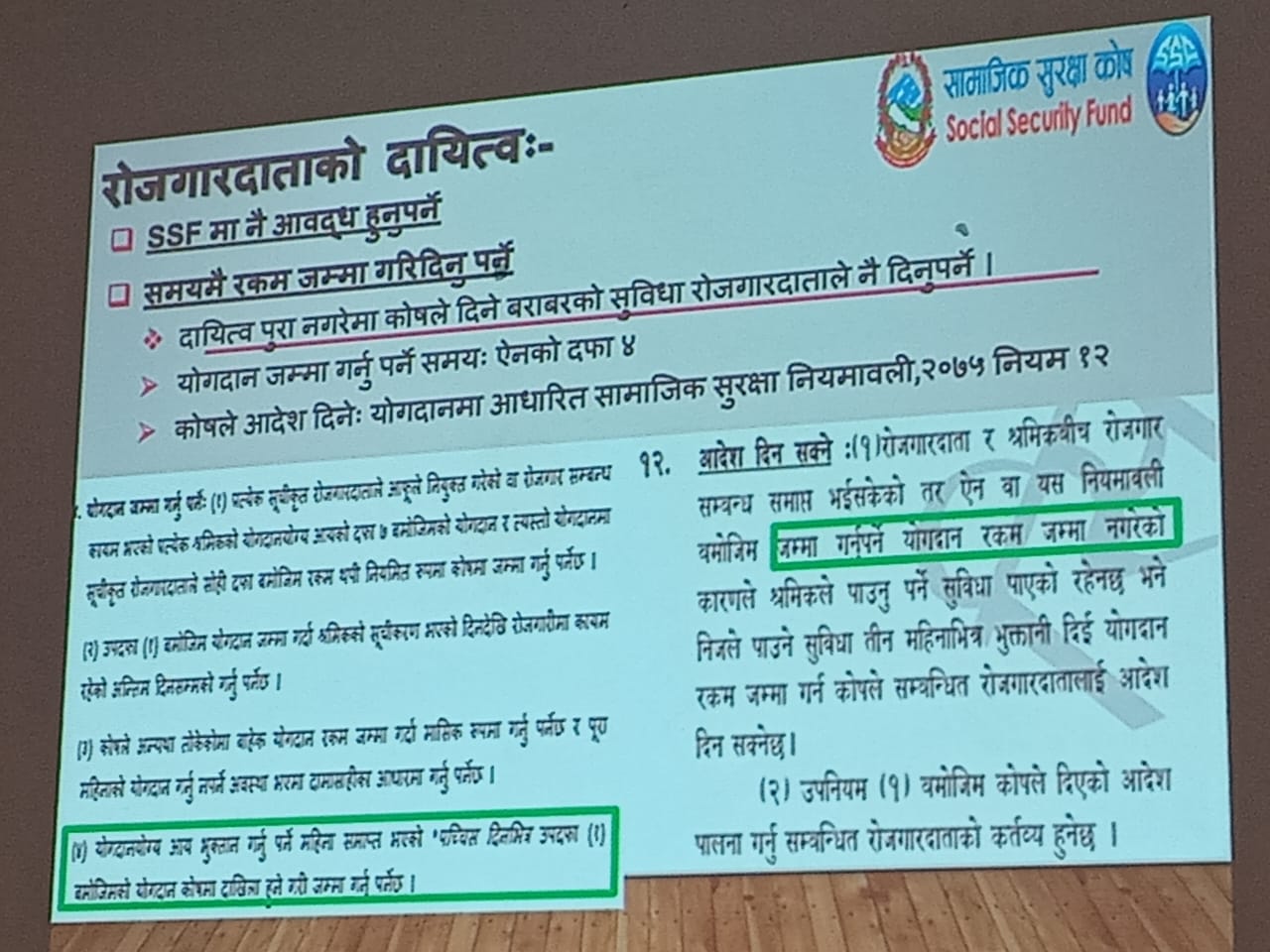
While the framework exists, enforcement remains inconsistent, particularly at local and ward levels. According to ILO reports, administrative gaps, weak inspection capacity, and low social security literacy hinder effective implementation.
Accountability and Ground-Level Concerns
A recurring theme at the program was the diffuse responsibility among different levels of government. Federal, provincial, and local governments are all legally responsible for funding and enforcing social security, yet there is no clear accountability mechanism.
As one attendee put it:
“Everyone is responsible, but no one is accountable.”
Other concerns raised by participants included:
• Worker skepticism: Many informal workers feel that they are investing their own money, and question whether the benefits will reach them.
• Data gaps: Local offices often lack accurate information on how many informal workers exist in each ward, making registration and enrollment difficult.
• Coverage gaps for government workers: Temporary and daily wage government employees (Jaladaris) have only recently become eligible, and even formal sectors are sometimes under-enrolled.
• Need for inclusive policy: Attendees urged the government to collect disaggregated data by caste, gender, and employment type to ensure social protection reaches the intended beneficiaries.
Call for Coordinated Action
The program emphasized that the central, provincial, and local governments must allocate adequate budgets, come together, and take shared responsibility for social security programs. Participants stressed that trade unions, employers, and media also have a role to play in raising awareness and monitoring implementation.
Despite progress, the low uptake among informal and self-employed workers, combined with poor local-level compliance, reflects the urgent need for a coordinated, accountable, and data-driven approach to social security in Nepal.
“We are the ones investing, yet we are unsure how it benefits us,” another attendee noted, reflecting widespread skepticism among informal workers.
Summary: The program in Dhangadhi highlighted the promise of Nepal’s social security framework but also revealed significant gaps in coverage, accountability, and awareness. Without clear responsibility, local data, and strong enforcement, the benefits of SSF remain largely theoretical for the majority of informal workers.
