
Sudurpaschim’s decades-long dream of medical education nears reality amid Dr. KC’s opposition
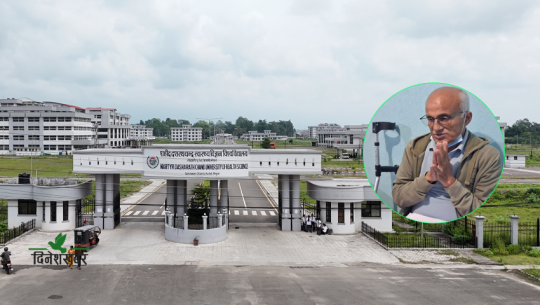
Dhangadhi: Sudurpaschim’s ambition to establish a medical college dates back nearly three decades. However, the journey toward realizing this dream has been marked by numerous obstacles, ranging from difficulties in felling trees and budget allocation to disagreements over the institution’s operational model, even after billions of rupees had been invested in infrastructure. Throughout the years, the people of the province have continued to wait for an institution that could produce doctors locally and provide specialized healthcare services.
Now, that long wait appears to be nearing an end. Student quotas have been allocated for four academic programs, including MBBS, at Shaheed Dasharath Chand Health Science University in Geta, Kailali. The Medical Education Commission has allocated 90 seats across the four programs, including 50 for MBBS, clearing the way for medical education to begin at the university.
However, just as the long-awaited plan approaches implementation, Prof. Dr. Govinda KC has launched a satyagraha (hunger strike), demanding that the decision to introduce the MBBS program in Geta be revoked. He argues that the program is being launched without adequate infrastructure, human resources, and compliance with legal standards. His demand to halt medical education in Geta, after decades of efforts to establish it, has raised serious concerns among the people of Sudurpaschim.
From the 1999 Foundation Stone to the University
The initiative to establish a medical college in Geta is not new. In 1999 (2056 BS), Jagadguru Jayendra Saraswati Shankaracharya of India's Kanchi Kamakoti Peetham laid the foundation stone for the proposed Ayurvigyan Medical College in Geta, Kailali. Some structures were also built through his investment.
That same year, the government allocated 77 bighas of land in Geta to the Jagadguru’s trust for the establishment of the medical college. However, the plan could not move forward.
A decade later, in 2066 BS, the government itself announced plans to establish a medical college in Geta. A feasibility study was conducted, the National Planning Commission allocated Rs 110 million, and a separate committee was formed to oversee infrastructure development.
In the years that followed, buildings were constructed, plans were revised, and debates continued over the institution’s operational model. Although physical infrastructure gradually took shape, uncertainty persisted over how the hospital and medical education programs would operate. Eventually, a 50-bed hospital began providing services in Geta in Kartik 2080 BS.
Although facilities with a capacity of more than 600 beds were prepared, the start date for the MBBS program remained uncertain. The Medical Education Commission’s recent decision to determine student intake capacity has now raised expectations that the long delay will finally end.
90 Seats Allocated: Why Is Dr. KC Opposing the Decision?
On Ashoj 30, the Medical Education Commission determined the student intake capacity for four academic programs at Geta for the 2083/84 academic session. The allocation includes 50 seats for MBBS, 20 for Nursing, 10 for B.Sc. in Medical Lab Technology, and 10 for B. Optometry.
The decision establishes a practical basis for beginning medical education at Geta. It also creates an opportunity to produce skilled human resources within the province and expand access to healthcare services.
However, Dr. KC has questioned the decision, arguing that the MBBS program should not begin until the necessary infrastructure, academic personnel, and legal requirements are fully in place. He has demanded that the decision to launch the program at Shaheed Dasharath Chand Health Science University be revoked.
Lokraj Pandey, coordinator of the struggle committee formed for the establishment of Geta Medical University, argues that Dr. KC’s demand undermines the decades-long struggle of the people of Sudurpaschim.
“After decades of struggle and hard work, the university at Geta has reached the stage of becoming operational,” Pandey said. “Dr. KC has repeatedly engaged in actions that prevent the dreams of the people of Sudurpaschim from being realized. However, we will not allow his own agenda to succeed.”
According to Pandey, the establishment of the university in Geta is not the achievement of any individual or government but the result of a prolonged collective struggle by the people of the province.
He views Dr. KC’s opposition in the context of his long-standing position that established institutions, such as Tribhuvan University’s Institute of Medicine (IOM) and the B.P. Koirala Institute of Health Sciences (BPKIHS), should instead be upgraded into universities.
Dr. KC has consistently maintained that if a medical university is to be established, it should be based at the Institute of Medicine under Tribhuvan University or at BPKIHS rather than in Geta.
The demand to scrap the MBBS program has also drawn criticism from the university’s leadership. Sunil Kumar Joshi, Vice-Chancellor of Shaheed Dasharath Chand Health Science University, described the demand as a serious attack on the institution.
“We feel that a serious attack has been launched against our noble institution, Shaheed Dasharath Chand Health Science University. This is an assault on our reputation and self-respect,” Joshi wrote.
He has also sought guidance from the people of Sudurpaschim and the general public across Nepal on how the institution should respond.
Meanwhile, Sudurpaschim civil society leader Pramod Pathak has argued that the controversy surrounding Geta should not be reduced to a simple question of supporting or opposing the university.
“Questions must be raised regarding human resources, infrastructure, hospital capacity, and the quality of education,” he said. “However, it is not appropriate to prevent the university from operating altogether simply by pointing out potential shortcomings. While it is necessary to remain vigilant to ensure the university functions properly, it is wrong to argue that Sudurpaschim does not need the university or that it should not be allowed to operate at all.”
Preparations Underway for Classes and Hospital Expansion from Magh
The university is preparing to begin medical education programs in the last week of the upcoming month of Magh. According to Registrar Dr. Bhim Chand, classes will commence in accordance with the academic calendar set by the Medical Education Commission.
He said the allocation of student quotas for programs, including MBBS, marks a significant achievement for the university and the medical education sector in Sudurpaschim.
Alongside the launch of academic programs, the university has also prioritized expanding services at its teaching hospital.
According to Registrar Chand, plans are underway to bring a 300-bed teaching hospital into full operation this year while also advancing preparations for a 500-bed hospital.
“We have already installed 622 beds,” Chand said. “The 300-bed hospital will be fully operational this year, and the 500-bed facility will also be initiated.”
He added that preparations are also underway to expand hospital services, including the introduction of CT scans, MRI facilities, and a cath lab.

Dineshkhabar Desk